Solve Last Layer Side Corners
Learn a simple move sequence to position and orient the last layer's side corner pieces on a Rubik's Cube, practicing sequences and spatial reasoning.
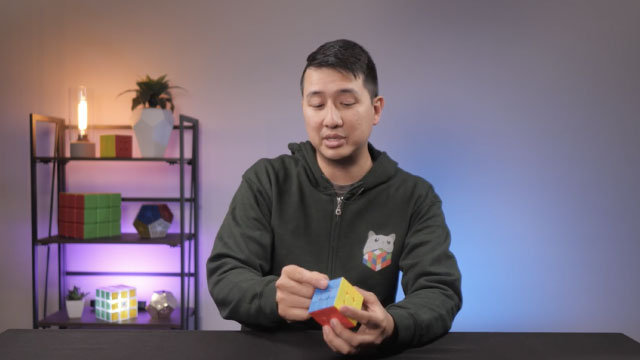
About this tutorial
Learn a simple move sequence to position and orient the last layer's side corner pieces on a Rubik's Cube, practicing sequences and spatial reasoning.
What you need
Step by step
- 1
Step 1
Put your Rubik's Cube on a flat surface and hold it so the last layer color you want to fix is on the top.
- 2
Step 2
Look at the four top corners and find a corner that does not have the top color facing upward.
- 3
Step 3
Turn the cube so that the misoriented corner is in the top-front-right position.
- 4
Step 4
Learn the move "R": turn the right face (the face on the right) 90 degrees toward you.
- 5
Step 5
Learn the move "D": turn the bottom (down) face 90 degrees toward you.
- 6
Step 6
Learn the apostrophe (') in a move name: it means to turn that face 90 degrees the other way (away from you).
- 7
Step 7
Memorize the short 4-move sequence R' D' R D and say it out loud slowly once.
- 8
Step 8
Perform the sequence R' D' R D over and over on the top-front-right corner until the top color on that corner faces up.
- 9
Step 9
Turn the top face (U) to bring the next misoriented corner into the top-front-right position.
- 10
Step 10
Repeat Step 8 and Step 9 until all four top corners have the top color facing upward.
- 11
Step 11
Learn the corner-permutation sequence U R U' L' U R' U' L so you can move top corners into the right positions.
- 12
Step 12
Hold the cube so a correctly placed top corner is in the back-right position and perform the corner-permutation sequence repeatedly until every top corner is in its correct spot; if no corner is correct do the sequence once from any position then try again.
- 13
Step 13
Check all faces of the cube to make sure every face matches its center color.
- 14
Step 14
Share your finished cube-solving success on DIY.org
Fun facts
How do I teach my child to solve the last layer side corners on a Rubik's Cube?
To teach last layer side corners, first learn cube notation and identify the last-layer corner you want to fix. Hold the unsolved corner at the front-right of the top layer, then repeat the simple twist sequence R' D' R D until the corner orients correctly. Rotate the top layer (U) to bring the next unsolved corner into position and repeat. Practice slowly, watching each turn, then increase speed as the child becomes confident.
What materials do I need to practice solving the last layer side corners?
You need a standard 3x3 Rubik's Cube, a printed algorithm sheet or small cheat card with notation, a quiet workspace, and a timer if doing practice drills. Optional items: stickerless cube for children, a simple stand to hold the cube, and access to a short video tutorial. Keep a notebook for tracking progress. No specialized tools are required.
What ages is this activity suitable for?
Suitable ages: generally children aged 7 and up can learn this with patience, basic finger dexterity, and ability to follow short algorithms. Younger children (5–6) can try with adult guidance and simplified steps. Tailor session length to attention span; 10–20 minute practice blocks work well. Adapt complexity — start with single-move sequences before introducing full algorithms.
What are the benefits of practicing last layer side corners with my child?
Practicing last layer side corners boosts spatial reasoning, pattern recognition, and sequential memory. It develops fine motor control, concentration, and patience while teaching problem-solving and perseverance. Timing drills add healthy goal-setting and progress tracking. For families, it's a bonding activity that supports STEM skills and confidence. Encourage short, regular practice sessions and celebrate small wins to keep motivation high.
Watch & Learn
Need help?
What can we use if we don't have a physical Rubik's Cube or it's too stiff to turn?
If you don't have a physical Rubik's Cube you can use a free online Rubik's Cube simulator or app and follow the same moves (R, D, U and the R' D' R D sequence) while keeping your target top color on the virtual top.
What should we do if a corner never seems to get the top color facing up even after repeating the moves?
If a corner never flips up, make sure that misoriented corner is in the top-front-right position (Step 3) and then repeat the R' D' R D sequence (Step 8) continuously on that corner until the top color faces up, without turning the top face between attempts.
How can we change the activity for younger kids or make it more challenging for older kids?
For younger kids (ages 4–7) have an adult place the misoriented corner in the top-front-right position and guide them slowly through saying and doing each R' D' R D move, while older kids can memorize both R' D' R D and the corner-permutation U R U' L' U R' U' L and time themselves for faster solves.
How can we extend or personalize the cube-solving activity after finishing the last layer corners?
To extend the activity, learn full OLL/PLL algorithms after mastering R' D' R D and the U R U' L' U R' U' L corner-permutation, time your solves to track improvement, and share videos or results on DIY.org as recommended in the instructions.