Craft a chain of string telephones
Make a chain of string telephones using paper cups, string, and tape; connect three or more cups and test sound transmission over distances.


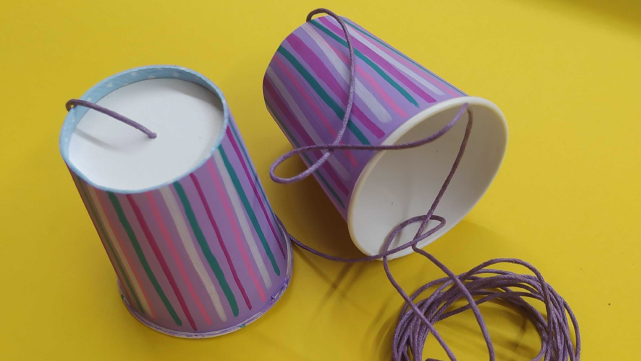

Step-by-step guide to make a chain of string telephones
Step 1
Gather all your materials and bring them to a clear workspace.
Step 2
Choose how many cups you want in your chain (pick three or more).
Step 3
Cut one piece of string for each connection between cups (number of cups minus one) each about 2 meters long.
Step 4
Make a small centered hole in the bottom of each cup using scissors with adult help.
Step 5
Thread one end of the first string through the hole of the first cup and tie a big knot inside to secure it.
Step 6
Thread the other end of that same string through the hole of the second cup and tie a big knot inside to secure both cups.
Step 7
Repeat threading and knotting with the next string to attach the next cup to the open end of the chain until all cups are connected.
Step 8
Hold the two end cups and pull the chain so every string is straight and tight without touching anything else.
Step 9
Have one person speak clearly into one cup while another person holds the far cup to their ear and listens.
Step 10
Slowly move farther apart while keeping the strings tight to see how far the sound will travel.
Step 11
Take a photo or video of your finished string telephone chain and share it on DIY.org.
Help!?
What can we use if we don’t have plastic cups, scissors, or 2-meter string?
Use paper cups or empty toilet-paper rolls instead of plastic cups, have an adult poke each hole with a skewer or nail if you don’t have scissors, and substitute yarn, shoelaces, or fishing line cut to about 2 meters for the string.
Why can’t we hear through the cups well and how do we fix it?
If sound is weak, check that each hole is small so the knot (as tied inside in the instructions) can’t slip, retie bigger knots, make sure every string is pulled straight and tight without touching anything else, and tape a knot inside the cup if needed.
How can I adapt the project for younger or older kids?
For younger kids have an adult cut small holes and pre-cut 1-meter yarn and use only two or three cups, while older kids can make longer chains of 6+ cups with 2-meter strings, experiment with distances and branching networks, and document results with photos or videos.
What are fun ways to personalize or extend the string telephone chain?
Decorate each cup with markers or stickers, add extra branches by tying additional strings to a cup to create a network of telephones, try different string types to compare sound quality, and record a video to share your finished chain on DIY.org.
Watch videos on how to make a chain of string telephones
How to Make a String Phone (In Two Minutes or Less)
3 Videos

How to Make a String Phone (In Two Minutes or Less)
String Telephones

String Telephones versus Sound tubes... STEM project.... Homemade Science with Bruce Yeany
Facts about sound and acoustics for kids
🎧 A string (or tin-can) telephone works because your voice makes the cup’s bottom vibrate, and those vibrations travel along a taut string to the other cup.
📏 Tension matters: a tighter string carries sound better — loose string makes the message fuzzy or disappear.
🥤 A paper cup acts like a tiny speaker diaphragm, turning air-pressure changes from your voice into vibrations the string can carry.
🧪 Tin-can/string telephones were a favorite Victorian toy and were also used to explore early ideas about transmitting sound.
🌬️ Fun speed fact: sound travels through air at about 343 m/s at room temperature, but along a taut string the vibrations can be heard across surprising distances.
How do I make a chain of string telephones with three or more paper cups?
What materials do I need to build a chain of paper-cup telephones?
What ages is a chain string-telephone activity suitable for?
What are the benefits and safety tips for doing a chain of string telephones?
