Ready with your calligraphy materials?
Practice basic calligraphy strokes and create a decorated name card using brush pens, ink, and guide sheets while learning letter shapes and spacing.
About this activity
Practice basic calligraphy strokes and create a decorated name card using brush pens, ink, and guide sheets while learning letter shapes and spacing.
What you need
Step by step
- 1
Step 1
Lay out your materials on a clean flat table so everything is easy to reach.
- 2
Step 2
Place a scrap paper under your name card to protect the table from ink.
- 3
Step 3
Slide a guide sheet under the name card so the guide lines show through the paper.
- 4
Step 4
Hold your brush pen at about a 45-degree angle.
- 5
Step 5
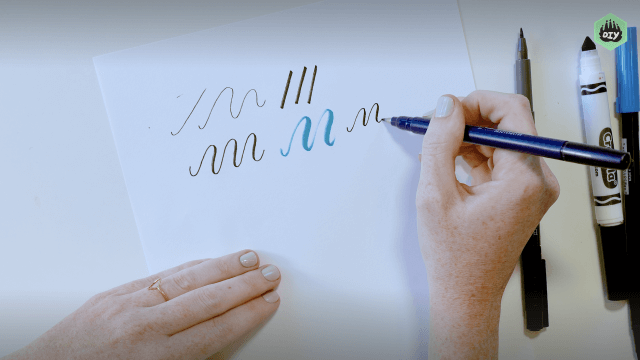
On scrap paper practice five light upstrokes and five heavier downstrokes using the same angle.
- 6
Step 6
On the guide sheet practice three ovals and three compound curves to learn letter shapes.
- 7
Step 7
Lightly draw pencil guidelines on your name card with the ruler to mark the baseline and x-height.
- 8
Step 8
Lightly sketch your name in pencil on the card following the guidelines and even spacing.
- 9
Step 9
Trace over each pencil letter with your brush pen using light pressure on upstrokes and heavier pressure on downstrokes.
- 10
Step 10
Wait until the ink is completely dry before touching the card.
- 11
Step 11
Gently erase the pencil lines from the card.
- 12
Step 12
Add small decorations or a border with colouring materials or a fine brush for dots and accents.
- 13
Step 13
Share your finished name card on DIY.org
Fun facts
How do I teach my child basic calligraphy strokes and make a decorated name card?
Start with warm-up drills: thick downstrokes, thin upstrokes, and simple ovals on guide sheets. Demonstrate pen angle and light vs. firm pressure. Have the child trace letters on traceable alphabets, then write letters freehand on practice paper. When confident, pencil-outline a name on card stock, ink over with brush pens, and add borders or simple florals. Let ink dry fully, erase pencil lines, and finish with small embellishments.
What materials do I need for a child-friendly calligraphy name-card project?
You’ll need soft brush pens or beginner-friendly nib pens, practice guide sheets, smooth practice paper, and heavier card stock for the final name card. Add a pencil, eraser, ruler, masking tape, scrap paper for testing strokes, a cup of water and cloth if using water-based brush pens, and non-toxic ink if using dip pens. Optional: metallic pens, stickers, or watercolor for decorations.
What ages is practicing basic calligraphy with brush pens suitable for?
Calligraphy practice is generally suitable for children aged about 6 and up, when fine motor control and patience are developing. Younger children (4–5) can try simple strokes with chunky brush pens and tracing activities. Older children (9+) can focus on consistent letterforms and spacing. Always match expectations to the child’s skill, give breaks, and offer one-on-one guidance for best results.
What are the benefits and safety tips for kids doing calligraphy, plus fun variations?
Calligraphy improves fine motor skills, hand–eye coordination, focus, and letter awareness while encouraging creativity. Safety tips: use non-toxic, washable inks, supervise any dip-pen or liquid ink use, protect surfaces with craft paper, and teach proper pen handling. Variations include watercolor brush pens, metallic inks, stencil-guided lettering, or creating themed cards (holiday, birthday) to keep practice engaging and varied.
Watch & Learn
Need help?
What can we use if we don't have a brush pen or a guide sheet?
If you don't have a brush pen, use a soft-tipped marker or a small round watercolor brush with diluted ink, and if you lack a guide sheet, draw or print guideline lines on regular paper and slide that under the name card as instructed.
My strokes look uneven or my letters aren't consistent—how can I fix that?
Practice more of the light upstrokes and heavier downstrokes on scrap paper (step 5) keeping the pen at a 45-degree angle, and repeat the ovals and compound curves on the guide sheet (step 6) before sketching on the name card to build consistent pressure and shapes.
How can I adapt this activity for younger children or older kids?
For younger kids simplify by using larger name cards, thick markers, and pre-drawn letters to trace, while older kids can add strict pencil guidelines with the ruler, increase guide-sheet drills from step 6, and practice more refined brush pressure control before inking.
What are some ways to personalize or enhance the finished name card?
After erasing pencil lines (step 10), personalize the card by adding a light watercolor wash before inking, using metallic pens or a fine brush for dots and accents in step 11, or embossing the dried ink for texture before sharing on DIY.org.