Fold an Origami Turtle
Fold an origami turtle step-by-step using square paper, learning patience and fine motor skills while creating a colorful model to display.
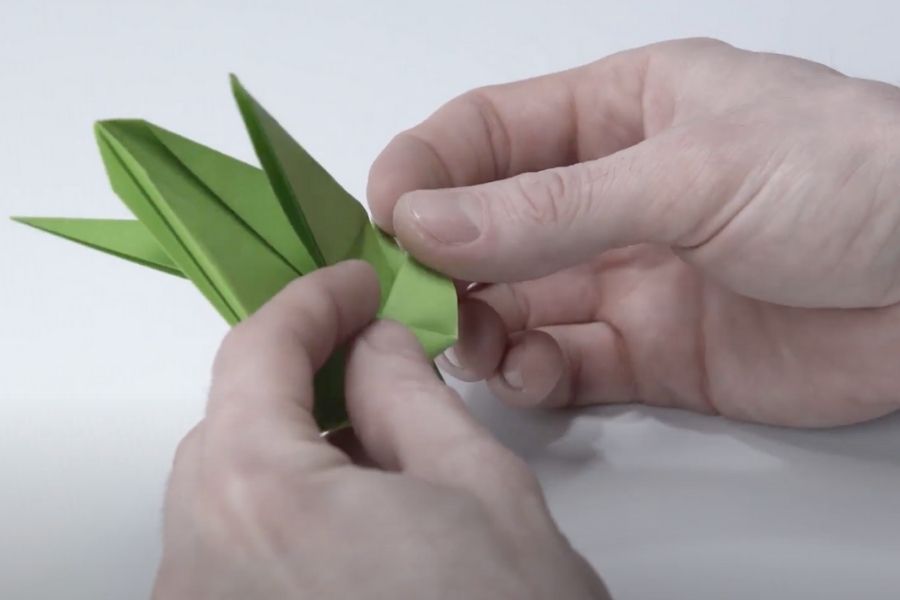
About this activity
Fold an origami turtle step-by-step using square paper, learning patience and fine motor skills while creating a colorful model to display.
What you need
Step by step
- 1
Step 1
Place your square paper color-side down on a flat table so the plain side is facing up.
- 2
Step 2
Fold the paper diagonally corner to corner and press the crease firmly.
- 3
Step 3
Fold the paper along the other diagonal and press the crease firmly.
- 4
Step 4
Bring two opposite corners together and flatten the paper into a triangle (this makes a waterbomb base).
- 5
Step 5
With the triangle point facing up fold the bottom left corner of the top layer up to meet the top point and press the crease.
- 6
Step 6
Fold the bottom right corner of the top layer up to meet the top point and press the crease.
- 7
Step 7
Flip the whole model over so the other side faces you.
- 8
Step 8
Fold the bottom left corner on this side up to meet the top point and press the crease.
- 9
Step 9
Fold the bottom right corner on this side up to meet the top point and press the crease.
- 10
Step 10
Fold the small top tip down about one centimeter to form the turtle’s head and press the crease.
- 11
Step 11
Fold the opposite bottom tip up slightly to make the tail and press the crease.
- 12
Step 12
Fold the four small side flaps outward so they stick out as the turtle’s legs and press each crease.
- 13
Step 13
Gently pinch the top center of the turtle’s shell to puff it a little so the shell looks round.
- 14
Step 14
Decorate the shell and body with your colouring materials to make a colorful turtle.
- 15
Step 15
Take a photo of your origami turtle and share your finished creation on DIY.org.
Fun facts
How do you fold an origami turtle step-by-step?
Start with a square sheet (color side down). Fold diagonally both ways and unfold to make creases. Fold the paper into a kite/base by bringing corners to the center. Perform a squash fold to form the turtle shell. Fold small triangles for the head, tail, and four flippers using valley folds and small reverse folds to shape joints. Tuck and flatten edges so the model sits upright. Add eyes with a marker. Work slowly and crease sharply for neat results.
What materials do I need to fold an origami turtle?
You only need a square sheet of origami paper (about 6–15 cm/2.5–6 in), a clean flat workspace, and something to make sharp creases like a bone folder or fingernail. Optional: a fine-tip marker for eyes, glue to reinforce folds, and patterned or colored paper for variety. Scissors aren’t necessary for this traditional fold; keep small items supervised for young children.
What ages are origami turtles suitable for?
This origami turtle works well for a range of ages. With adult help, children aged 4–7 can learn basic folds and assemble a simple turtle. Ages 8–12 usually manage the full step-by-step independently, improving patience and fine motor skills. Teenagers and adults can enjoy more complex variations. Adjust instructions and supervision based on your child’s attention span and scissors/marker use.
What are the benefits and safety tips for folding origami turtles?
Folding origami turtles builds fine motor control, patience, spatial reasoning, and following sequential steps. It’s a low-cost, screen-free craft that boosts confidence when children complete a model. Safety: supervise children under 6 to avoid paper cuts or putting paper in mouths; keep markers and glue away until adult approves. Variations: use foil or patterned paper, make a family of turtles in different sizes, or turn the turtle into a greeting card by mounting it on cardstock.
Watch & Learn
Need help?
What can I use if I don't have square origami paper?
Cut a square from printer paper (for example 15×15 cm), a colourful magazine page, or a Post-it and then place the square paper color-side down as the first instruction requires.
I'm stuck making the waterbomb base—how do I avoid tearing or misaligning the folds?
Before bringing opposite corners together to flatten into the triangle, press both diagonal creases firmly and guide the layers gently with your thumbs so the waterbomb base collapses cleanly without tearing.
How can I adapt this origami turtle for different ages?
For younger children use larger, sturdier paper and pre-crease the diagonals and the corner-to-top folds while older kids can work with smaller squares, practice precise folds like the small head tip fold, and add detailed shell decoration.
How can we extend or personalize the finished turtle?
After puffing the shell, decorate it with markers, stickers, or paint, glue on googly eyes to the folded head, make several sizes to form a turtle family, and then photograph your creations to share on DIY.org as suggested.