Make an Origami Frog!
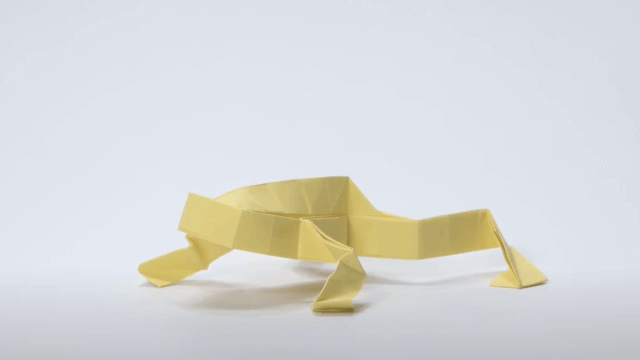
Fold a jumping origami frog from paper, follow step by step creases and folds, decorate it, and test how far your frog can jump.
About this activity
Fold a jumping origami frog from paper, follow step by step creases and folds, decorate it, and test how far your frog can jump.
What you need
Step by step
- 1
Step 1
Place the rectangular paper landscape (long side left to right) on your flat surface.
- 2
Step 2
Fold the paper in half by bringing the top edge down to meet the bottom edge and make a sharp crease.
- 3
Step 3
Unfold the paper so it lies flat again with the horizontal crease across the middle.
- 4
Step 4
Fold the bottom edge up to meet the middle crease and make a sharp crease.
- 5
Step 5
Fold the top edge down to meet the middle crease and make a sharp crease.
- 6
Step 6
Fold the paper in half by bringing the left side over to the right side and make a sharp crease so the folded edges are on the outside.
- 7
Step 7
Fold the top left corner down so its point meets the center of the short edge and crease to form one side of the frog’s head.
- 8
Step 8
Fold the top right corner down the same way so both corners make a triangle at that short edge.
- 9
Step 9
Flip the paper over so the triangle points are now on the underside.
- 10
Step 10
Fold the small triangle end (the head) back toward the center about 1 cm and crease to lock the head shape.
- 11
Step 11
Decorate your frog with colouring materials to add eyes a mouth and fun spots.
- 12
Step 12
Press down on the back folded section with your finger and release to make your frog jump and measure how far it goes.
- 13
Step 13
Take a photo or write about your jumping frog and share your finished creation on DIY.org
Fun facts
How do you make a jumping origami frog?
Start with a square sheet of paper. Fold it in half horizontally and unfold to mark the center. Fold top corners to the center crease to form a kite, then fold the top triangle down. Flip, fold the bottom edge up to form the frog’s rear, and crease a “spring” fold (a folded flap that you can press). Shape the hind legs with small diagonal folds. Decorate, press the back flap, then release to make your frog jump.
What materials do I need to make an origami frog?
You need one square of paper (origami paper or cut square from printer paper), markers or crayons for decorating, stickers (optional), and a flat surface to fold on. Optional items: a ruler for crisp creases, a bone folder or fingernail for sharper folds, and small weights (tape or a tiny paper clip) if you want to experiment with jump distance. Scissors and glue are optional for custom shapes.
What ages is making an origami frog suitable for?
This activity suits children about 6 years and up who can follow step-by-step folding instructions and use fine motor skills. Younger children (3–5) can join with adult help for pre-folding and decorating. Toddlers can help choose colors and stickers. Supervision is recommended for any cutting or small decorative pieces to avoid choking hazards. Adjust the complexity by simplifying folds or offering ready-made shapes.
What are the benefits and fun variations of making an origami frog?
Folding frogs builds fine motor skills, spatial reasoning, patience, and following multi-step instructions. Testing jump distance adds playful STEM learning—measure and record results to practice math. Variations: use different paper sizes to change jump power, add tiny weights for longer hops, waterproof with tape for outdoor play, or create a frog-racing track. Always supervise small parts and sticky decorations for safety.
Watch & Learn
Need help?
What can we use if we don't have the rectangular paper or special colouring materials mentioned in step 1 and step 11?
Cut a sheet of A4 or letter printer paper to a rectangle and place it landscape for step 1, and use crayons, markers, stickers, or magazine cutouts as substitutes for the colouring materials in step 11.
My folds look uneven and the triangle head won't form—what should I check during steps 6–10?
Reopen and realign the edges before re-creasing, use a fingernail or ruler to make sharp creases for folds in steps 2–6, and ensure the top left and right points exactly meet the center of the short edge in steps 7–8 before flipping in step 9 and making the 1 cm back-fold in step 10 to lock the head.
How can I adapt this origami frog activity for a 3-year-old versus a 10-year-old?
For a 3-year-old, pre-fold the long horizontal and middle creases (steps 2–5) and let them do the corner folds and decorating (steps 7–11), while a 10-year-old can try different paper sizes, precise 1 cm back-folds (step 10) and more detailed decoration or patterning in step 11.
What are simple ways to make the frog jump farther or personalize it before sharing in step 13?
After reinforcing the creases and practicing the press-and-release on the back folded section (step 12), try adding a small paperclip under the back flap or adjusting the 1 cm head lock (step 10) and personalize with markers or googly eyes in step 11, then measure the distance to record for step 13.