Your Favorite Speech
Write and practice your favorite short speech, design simple cue cards or props, then deliver and record it to improve confidence and speaking skills.


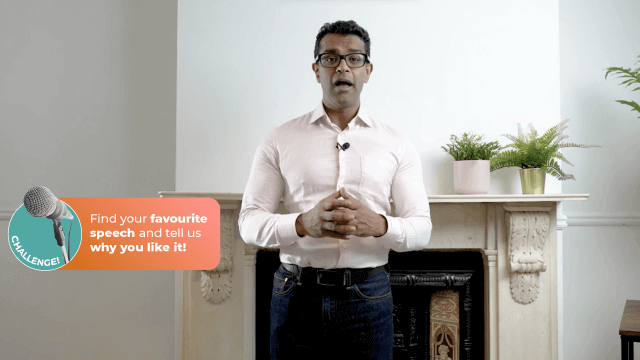

Step-by-step guide to write and deliver your favorite short speech
Step 1
Choose a topic you love to talk about like a hobby a favorite book a pet or something funny.
Step 2
Decide how long your speech will be for example 30–60 seconds or 1–2 minutes.
Step 3
Write one clear opening sentence that tells your audience what your speech is about.
Step 4
Write the first short main point that explains why you picked this topic.
Step 5
Write the second short main point that gives another reason or example.
Step 6
Write a short closing sentence that wraps up and thanks your listeners.
Step 7
Read your whole speech out loud slowly to check for words you want to change.
Step 8
Take three index cards or fold three small pieces of paper to make cue cards.
Step 9
On each card write one main point in big clear letters so you can see them while speaking.
Step 10
Add a tiny drawing or a keyword on each card to help you remember the point.
Step 11
Pick one small prop or costume piece from home that matches your topic and place it where you will perform.
Step 12
Practice delivering your speech aloud three times using the cue cards and the prop.
Step 13
Record your speech one time ask an adult for help if you need it.
Step 14
Watch your recording once and notice one thing you did well.
Step 15
Share your finished speech on DIY.org
Help!?
What can we use if we don't have index cards, a small prop, or a camera to record the speech?
Fold three pieces of printer paper or cut thin cardboard from a cereal box for the cue cards, use a toy, printed picture, or kitchen item as the 'small prop or costume piece,' and record the speech with a phone, tablet, or an adult's camera as part of the 'record your speech one time' step.
What should we do if the child keeps forgetting lines or gets too nervous when recording?
If lines are forgotten or nerves appear during the 'practice delivering your speech aloud three times' and recording steps, slow the pace, rely on the big clear letters and tiny drawings on each cue card, rehearse the speech more than three times, and ask an adult to help with the recording.
How can this activity be adapted for younger kids or older kids?
For younger children, choose a 30–60 second length, help write the single opening sentence and use big drawings on each of the three cue cards, while older kids can aim for 1–2 minutes, add an extra main point or a fourth card, practice more than three times, and polish the recording before sharing on DIY.org.
How can we make the speech more creative or longer-term as a project?
To enhance the activity, create a matching poster or simple slides to place behind you when you 'pick one small prop or costume piece,' add a costume or sound effects, practice additional runs, watch the recording to note one thing you did well and one improvement, and then share the finished speech on DIY.org.
Watch videos on how to write and deliver your favorite short speech
5 Essential Strategies for Supporting Students with Speech and Language Needs 💬 | Teaching Tips
4 Videos

5 Essential Strategies for Supporting Students with Speech and Language Needs 💬 | Teaching Tips
How to Teach... with Editable Speech Bubbles

11. Language Development: What Do Children Say? (audio only)

Developing Students' Language Skills
Facts about public speaking for kids
🎤 Around 75% of people list public speaking as a top fear — you're definitely not alone!
🕒 TED Talks are famously limited to about 18 minutes to keep ideas short and powerful.
🏛️ Ancient Greek thinkers like Aristotle laid the foundations of speech techniques over 2,000 years ago.
🗣️ Rehearsing your speech out loud with cue cards helps cut filler words like “um” and boosts clarity.
🏆 Toastmasters International, founded in 1924, is a global community that helps people practice and improve public speaking.
How do I run the 'Your Favorite Speech' activity with my child?
What materials do I need for the 'Your Favorite Speech' activity?
What ages is the 'Your Favorite Speech' activity suitable for?
What are the benefits and safety tips for 'Your Favorite Speech'?
