Share Paper Cutting Safety Precautions
Make a colorful safety poster listing paper cutting precautions, practice safe cutting with child scissors, and prepare to share tips with others.


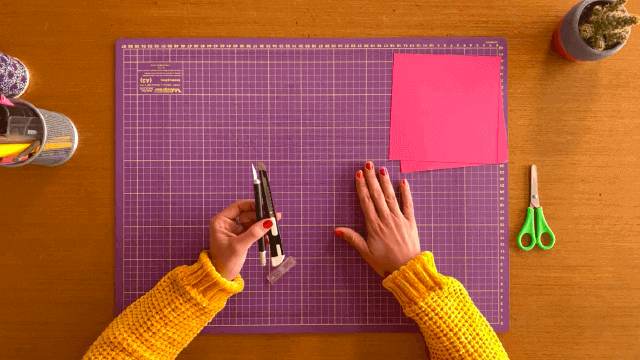

Step-by-step guide to share paper cutting safety precautions
Step 1
Choose a flat workspace with good light where you can sit comfortably.
Step 2
Gather all the materials and put them on your workspace.
Step 3
Write 4 to 6 paper-cutting safety tips on scrap paper to plan what to include.
Step 4
Write a big title lightly with pencil at the top of your poster paper.
Step 5
Use a ruler to draw boxes or sections on the poster for each safety tip.
Step 6
Practice cutting one straight line on scrap paper with your child-safe scissors while sitting down.
Step 7
Practice cutting a curve and a small shape on scrap paper with your child-safe scissors while sitting down.
Step 8
Cut out the decorative shapes you want to add to the poster from scrap paper.
Step 9
Write each safety tip neatly in its own box on the poster with your coloring materials.
Step 10
Attach your decorative shapes to the poster using glue or tape.
Step 11
Add bright colors and simple safety icons to make each tip easy to understand.
Step 12
Practice saying your top three safety tips out loud so you can teach others clearly.
Step 13
With an adult's help share your finished safety poster on DIY.org.
Help!?
What can I use if I don't have child-safe scissors, poster paper, or a ruler?
Use blunt-tipped adult scissors with close supervision instead of child-safe scissors, substitute construction paper or cardstock for poster paper, and use a straightedge like a closed book or a piece of cardboard in place of a ruler while following the step to draw boxes or sections.
I'm having trouble cutting neat shapes and straight lines—what should I do?
Follow the instructions to practice cutting one straight line and a curve on scrap paper while sitting down, draw your guideline with the ruler first, rotate the scrap paper rather than the scissors, and make slow, small snips to gain control.
How can I adapt this poster activity for different age groups?
For younger children, an adult can pre-draw boxes and pre-cut decorative shapes for them to glue and color, while older kids can use stencils and the ruler to create cleaner boxes, write more detailed tips with coloring materials, and prepare to share a short explanation on DIY.org.
How can we enhance or personalize the finished safety poster?
Attach photos or original drawings next to each tip, add bright colors and simple icons from the coloring materials, reinforce edges with tape after you attach decorative shapes, and record a short clip of you practicing your top three safety tips to include when you share the poster on DIY.org.
Watch videos on how to share paper cutting safety precautions
HOW TO HOLD SCISSORS & CUT PAPER | Quick Tips to Teach Your Child How to Improve Cutting Skills
3 Videos
HOW TO HOLD SCISSORS & CUT PAPER | Quick Tips to Teach Your Child How to Improve Cutting Skills
Teaching Scissor Safety with Kindergarten
✂️ Managing the Scissors- Teaching Students to Cut, Scissor Safety, and More!
Facts about scissor and craft safety for kids
✂️ Scissors are one of the oldest hand tools — versions of cutting tools date back thousands of years and pivoted metal scissors appeared in ancient Rome.
🩹 For small paper cuts, cleaning with soap and water, applying gentle pressure to stop bleeding, and covering with a bandage helps prevent infection.
📄 Paper can cause surprisingly painful 'paper cuts' because the thin edge focuses pressure on a tiny area and can nick nerve-rich fingertips.
🎨 Colorful posters and pictures make safety tips easier to remember — visuals are especially helpful when teaching kids.
👶 Child-safe scissors have rounded tips and blunter blades so they can still cut paper but lower the chance of puncture injuries.
How do I make a paper-cutting safety poster and practice safe cutting with kids?
What materials do I need for a paper-cutting safety poster?
What ages is this paper-cutting safety activity suitable for?
What are the benefits of making a paper-cutting safety poster?
