Try a new Uke Strumming Pattern
Learn and practice a new ukulele strumming pattern using simple chords, counting beats, and playing along with a slow song to build rhythm skills.


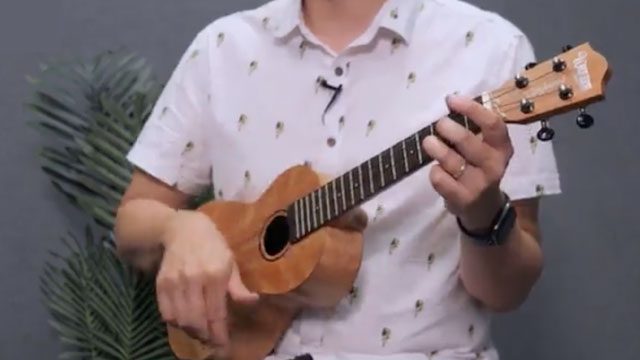

Step-by-step guide to try a new uke strumming pattern
Step 1
Tune your ukulele so each string sounds clear and in tune before you start.
Step 2
Sit comfortably and hold the ukulele on your lap with the neck in your left hand and the body against your chest.
Step 3
Make a C chord by pressing one finger on the 3rd fret of the bottom string and keep the other strings open.
Step 4
Make an Am chord by pressing one finger on the 2nd fret of the top string and keep the other strings open.
Step 5
Make an F chord by pressing your middle finger on the 2nd fret of the top string and your index finger on the 1st fret of the second string.
Step 6
Make a G chord by placing three fingers: index on the 2nd fret of the third string middle on the 2nd fret of the bottom string and ring on the 3rd fret of the second string.
Step 7
Practice the new strumming pattern slowly using only your strumming hand: play Down Down Up Up Down Up while counting "1 2 & 3 & 4 &" out loud.
Step 8
Strum the same pattern once while holding the C chord so the pattern matches the sound of the chord.
Step 9
Play the chord progression C then G then Am then F and strum the full pattern once for each chord, moving slowly between chords.
Step 10
Put on a slow song with a steady beat and play the chord progression while keeping the strumming pattern and counting out loud to stay steady.
Step 11
Share your finished performance of the new ukulele strumming pattern on DIY.org.
Help!?
What can I use if I don't have a tuner to 'tune your ukulele so each string sounds clear and in tune'?
If you don't have a tuner, use a free tuning app or online tuner on a phone, a piano or pitch pipe to match pitches, or tune by ear using the 4th-fret relative tuning method on the top string until each string sounds clear as instructed.
My chords sound buzzy or I can't switch from C to G while keeping the 'Down Down Up Up Down Up' pattern—what should I try?
Press your fingers closer to the fretwire and practice the strumming pattern slowly with only your strumming hand as in step 6, then move between C, G, Am, and F very slowly (step 8) while counting '1 2 & 3 & 4 &' to fix buzzing and timing issues.
How can I adapt this activity for younger children or more advanced players?
For younger kids simplify by practicing only the C chord with single Down strums and counting '1 2 & 3 & 4 &' while older players can speed up the Down Down Up Up Down Up pattern, add dynamics, or play along to a faster song from step 9.
How can we extend or personalize the final performance before sharing on DIY.org?
Personalize by choosing a favorite slow song from step 9 to sing along while playing the C-G-Am-F progression with the Down Down Up Up Down Up pattern, add a short melody or percussive slap between chord changes, and record the performance to share on DIY.org as directed in step 10.
Watch videos on how to try a new uke strumming pattern
Ukulele Beginners! Learn a COOL NEW Strumming Pattern FAST!
4 Videos

Ukulele Beginners! Learn a COOL NEW Strumming Pattern FAST!

4 Easy Ukulele Strumming Patterns For Beginners

How to STRUM a Ukulele + 5 BEGINNER Strumming Patterns!

Complete Ukulele Rhythm & Strumming Guide for Beginners
Facts about ukulele basics for kids
🎸 The ukulele arrived in Hawaii in the late 1800s, adapted from small Portuguese instruments like the machete.
🎶 Many strumming patterns are just combinations of simple down and up strokes—counting "1 & 2 &" makes them easy to follow.
🧭 A handful of basic chords (like C, G, F, and Am) lets you play hundreds of beginner-friendly songs on the uke.
⏱️ Practicing slowly with a metronome or a slow song (try 60–80 BPM) is one of the fastest ways to improve steady timing.
🖐️ With four nylon strings and a small neck, the ukulele is especially comfy for kids and small hands.
How do you try a new uke strumming pattern with a child?
What materials do I need to practice a uke strumming pattern?
What ages is learning a uke strumming pattern suitable for?
What are the benefits of practicing ukulele strumming patterns?
