What Uke Do You Have?
Examine your ukulele: measure length, count frets, listen to tone, record observations, and draw labeled diagrams to identify which ukulele you have.


Step-by-step guide to identify your ukulele
Step 1
Place your ukulele flat on a table so you can see the whole instrument clearly.
Step 2
Measure the total length from the top of the headstock to the bottom of the body with your ruler or tape measure.
Step 3
Write the total length measurement on your paper.
Step 4
Measure the scale length from the nut to the saddle with your ruler or tape measure.
Step 5
Write the scale length measurement on your paper.
Step 6
Count the number of frets on the fretboard.
Step 7
Write the number of frets on your paper.
Step 8
Play each open string one at a time so you can hear how each string sounds.
Step 9
Write a short note beside each string describing whether the sound is bright high or deep low.
Step 10
Draw the outline of your ukulele on your paper.
Step 11
Label the main parts on your drawing such as headstock neck fretboard frets body soundhole bridge and strings.
Step 12
Use your measurements fret count and sound notes to decide which type of ukulele you think it is and write your guess on the paper.
Step 13
Color your drawing to match your ukulele and make it look awesome.
Step 14
Share your finished creation on DIY.org.
Help!?
What can we use if we don't have a ruler, tape measure, or coloring supplies for the activity?
Use a piece of string to follow the headstock-to-body length and the nut-to-saddle scale length and then lay the string against a printable ruler or smartphone ruler app, and substitute notebook paper and crayons or markers for drawing and coloring.
I'm having trouble measuring the scale length or getting accurate open-string sounds—what should I check or change?
Make sure the ukulele is flat and stable on the table (use a non-slip mat), identify the nut edge and saddle top clearly by pressing each open string lightly at the first fret if needed, and retune or pluck strings firmly so you can hear and write accurate bright/low notes.
How can I adapt the steps for younger children or make it more challenging for older kids?
For younger kids, have them trace the ukulele outline, count frets with stickers, and label parts with preprinted names, while older kids can measure to millimeters, record pitches with a tuner app, and research ukulele types using their measurements and fret counts.
What are some ways to extend or personalize the finished ukulele drawing and project before sharing on DIY.org?
Enhance the project by adding a color-coded key for string sounds, creating a small table of total length, scale length and fret count, decorating the drawing with stickers or paint to match your uke, and recording a short video of the open strings to upload with your identification reasoning.
Watch videos on how to identify your ukulele
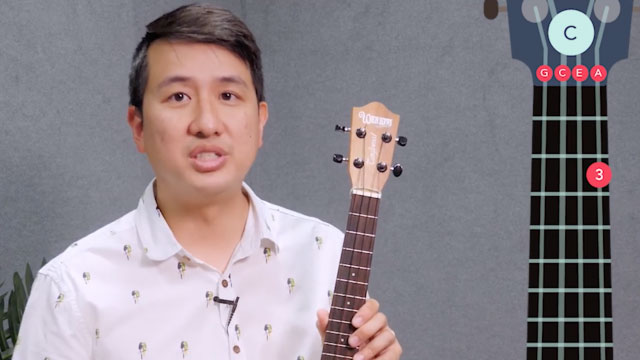
Beginner Ukulele Lesson 1 - The Ukulele Basics
4 Videos

Beginner Ukulele Lesson 1 - The Ukulele Basics

How to Play Ukulele - The Ultimate Beginner's Guide #ukulele #tutorial
How To Strum The Ukulele - Beginner Uke Like The Pros Tutorial

Learn How To Play UKULELE in 1 HOUR - Class for Total Beginners
Facts about ukulele types and parts
🎸 Most ukuleles have four strings and are commonly tuned G–C–E–A (many use a re-entrant high G for that bouncy sound).
📏 There are four main sizes—soprano, concert, tenor, and baritone—soprano is smallest and brightest while baritone is largest and deepest.
🔎 Counting frets and measuring scale length are fast ways to identify a uke; the 12th fret marks the octave where the string vibrates at half its length.
🌳 The wood matters: koa, a traditional Hawaiian wood, is prized for giving ukuleles a warm, bell-like tone.
🎶 Baritone ukuleles are usually tuned D–G–B–E (the same as a guitar’s top four strings), so they sound lower and more guitar-like.
How do you do the 'What Uke Do You Have?' activity?
What materials do I need for the 'What Uke Do You Have?' ukulele activity?
What ages is the 'What Uke Do You Have?' activity suitable for?
What are the benefits of doing the 'What Uke Do You Have?' activity?
