Beatbox the Boom Bap Beat!
Learn to beatbox a classic boom bap beat by practicing mouth sounds, breathing patterns, and simple rhythms, then perform your own four bar loop.


Step-by-step guide to beatbox the Boom Bap beat
Step 1
Sit in a quiet spot with your mirror in front of you.
Step 2
Set your timer or metronome to 90 beats per minute.
Step 3
Warm up by taking 10 deep breaths through your nose and exhaling slowly through your mouth.
Step 4
Practice the kick drum "B" by puffing your lips and making a short unvoiced "buh" ten times.
Step 5
Practice the hi-hat "T" by pushing air over your tongue to make a crisp "tss" sound ten times.
Step 6
Practice the snare "K" by popping the back of your tongue for a sharp "kah" or try a "pf" lip pop ten times.
Step 7
Count four beats out loud while tapping your knee once on each beat.
Step 8
On each counted beat, make the sounds B on 1 T on 2 K on 3 and T on 4 slowly until it feels steady.
Step 9
Turn the metronome on at 90 BPM and practice the B T K T loop in time for eight measures.
Step 10
Breathe quickly in through your nose between measures so you have air for the next bar.
Step 11
Try a small variation by replacing the snare on one measure with two quick "k-k" hits.
Step 12
Practice your four-bar loop three times in a row with steady timing and clear sounds.
Step 13
Share your finished four-bar loop performance on DIY.org.
Help!?
What can we use if we don't have a mirror or a metronome for this activity?
Use your phone's front camera or a window reflection as the mirror and a metronome app or a parent tapping a steady 90 BPM (or counting aloud) to replace the metronome in Step 2 and Step 8.
I'm having trouble making the snare 'K' or the 'pf' lip pop sound—what should I try?
If the snare in Step 5 feels hard, try the 'pf' lip pop alternative from Step 5, slow the movement down to feel tongue placement, and repeat the warm-up breaths from Step 3 before practicing again.
How can I modify this beatbox activity for younger kids or for older kids who want more challenge?
For younger kids, lower the metronome in Step 2 to about 60–70 BPM and reduce repetitions in Steps 4–6 and the number of measures in Step 9, while older kids can raise the BPM, add extra four-bar loops, or speed up the two quick 'k-k' variation from Step 11.
What are simple ways to extend or personalize our four-bar boom bap loop after we can play it steady?
Try layering a clap or finger snap on beats 2 and 4, record yourself on a phone to overdub a second layer, use the two quick 'k-k' variation from Step 11 in different bars, and then share the finished performance on DIY.org as in Step 14.
Watch videos on how to beatbox the Boom Bap beat
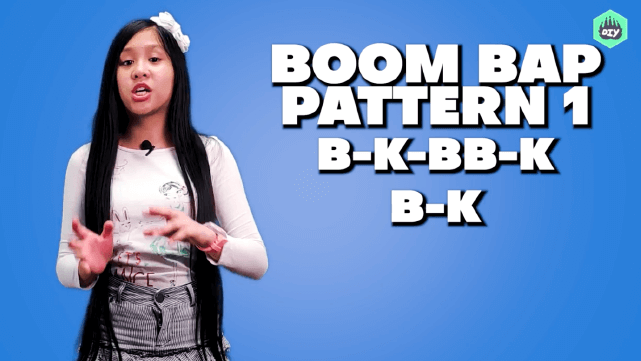
How to Beatbox for Kids! 🎤 Fun & Easy Beatboxing with Aunt Jazz Using Letter Sounds!
4 Videos

How to Beatbox for Kids! 🎤 Fun & Easy Beatboxing with Aunt Jazz Using Letter Sounds!
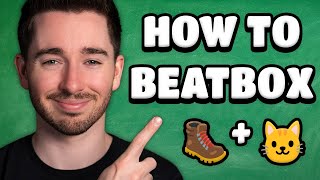
How To Beatbox For Beginners: Learn The Basics (Part 1)
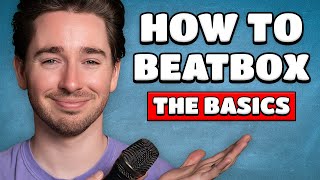
How To Beatbox The Basics (10 Beginner Sounds)

6 Fun HipHop Beats - Beatbox Patterns for Beginners (Tutorial)
Facts about beatboxing and vocal percussion
🥁 Boom bap gets its name from the "boom" kick and "bap" snare sounds that give the style its punchy groove.
🎤 Beatboxing can mimic drums, basslines, and even DJ scratches using only the mouth, lips, tongue, and voice.
💨 Skilled beatboxers use inward sounds or smart breathing to keep rhythms going without long pauses for breath.
⏱️ At 90 BPM a four-bar loop (16 beats) lasts about 10.7 seconds — a perfect practice chunk for kids.
🔁 Loop pedals let you record a four-bar loop and layer more sounds so one performer can build a whole track.
How do you beatbox a classic boom bap beat?
What materials do I need to teach a child beatbox the boom bap beat?
What ages are suitable for learning beatbox boom bap?
What are the benefits, safety tips, and variations for beatboxing a boom bap beat?
