Spin around the Orbit
Build a simple spinning solar system model using a central sun and attached planets on strings to observe orbital motion and balance.



Step-by-step guide to build a spinning solar system model
Step 1
Gather all the materials on a clear table so everything is easy to reach.
Step 2
Cut a circle from the cardboard or use a paper plate as your spinning base.
Step 3
Make a neat hole in the exact center of the circle using the hole punch or a sharp pencil.
Step 4
Push the pencil or skewer through the center hole so it stands upright and tape the pencil under the plate to hold it steady.
Step 5
Attach the sun to the top of the pencil by taping or gluing a big pom pom or ball onto the pencil tip.
Step 6
Color and decorate each small ball pom pom or bead to look like planets using your coloring materials.
Step 7
Tie one end of a piece of string to each planet so each planet has its own hanging string.
Step 8
Make several small holes evenly spaced around the edge of the plate with the hole punch or sharp pencil.
Step 9
Thread each planet string through a different hole so the planets hang outside the plate edge.
Step 10
Tie knots under the plate to secure each planet string at the length you want for that orbit.
Step 11
Gently spin the plate by flicking the pencil or skewer and watch the planets swing around the sun in orbit.
Step 12
If planets tangle or bump the sun then stop spinning and shorten or lengthen the string by retying until they swing freely.
Step 13
Share your finished spinning solar system on DIY.org
Help!?
What can I use if I don't have cardboard, a paper plate, or a pencil/skewer?
Use a stiff plastic lid or a piece of cereal box cardboard for the spinning base and a wooden dowel, thick marker, or even a blunt straw with tape under the base in place of the pencil/skewer to stand upright and be taped under the plate as described.
Why does my plate wobble or the planets keep tangling when I spin it?
Make sure the center hole is neat and the pencil/skewer is taped firmly under the plate as in the instructions, then stop spinning and shorten or lengthen the planet strings by retying the knots until they swing freely without tangling.
How can I adapt this spinning solar system for younger or older kids?
For younger children, an adult should pre-cut the center and edge holes and use larger pom poms with shorter strings so planets hang securely, while older kids can paint detailed planets, add moons, or make more holes for extra orbits.
How can we make the activity more creative or challenging after finishing the basic spinner?
Decorate and label each planet as in the coloring step, vary string lengths to reflect orbital distances, add rings with beads or pipe cleaners, or attach a small motor or glitter pom pom sun to enhance spinning and personalization.
Watch videos on how to build a spinning solar system model
Learn ALL About Orbits In Space! | KLT
4 Videos
Learn ALL About Orbits In Space! | KLT
Earth's Orbit & Rotation Video Lesson for Kids | Science Lesson for Grades 3-5 | Mini-Clip
Movement of the Planets in our Solar System Animation | Twinkl Go!
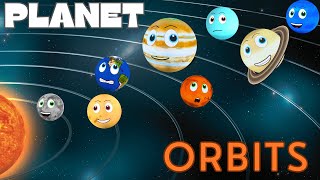
Planet Orbits | Orbit time Comparison | Solar System for Kids
Facts about solar system models and orbital motion
☀️ The Sun contains about 99.86% of the entire Solar System's mass — it's the heavyweight champion!
🪐 Jupiter is more than twice as massive as all the other planets combined, making it the Solar System's giant.
🕰️ An orrery is a hand-cranked mechanical model of the Solar System that people have used since the 18th century to show planetary motion.
🎯 When you spin a planet on a string, the string's tension provides the centripetal force that keeps it moving in a circle.
⚖️ Balancing the lengths and weights of your model's planet strings reduces wobble — tiny adjustments make the orbits steadier.
How do you do the Spin around the Orbit activity?
What materials do I need for Spin around the Orbit?
What ages is this activity suitable for?
What are some variations of the Spin around the Orbit activity?
