Drawing Human Hands & Feet
Practice drawing human hands and feet using simple observation, sketching shapes, shading, and step-by-step techniques to improve proportion and gesture.


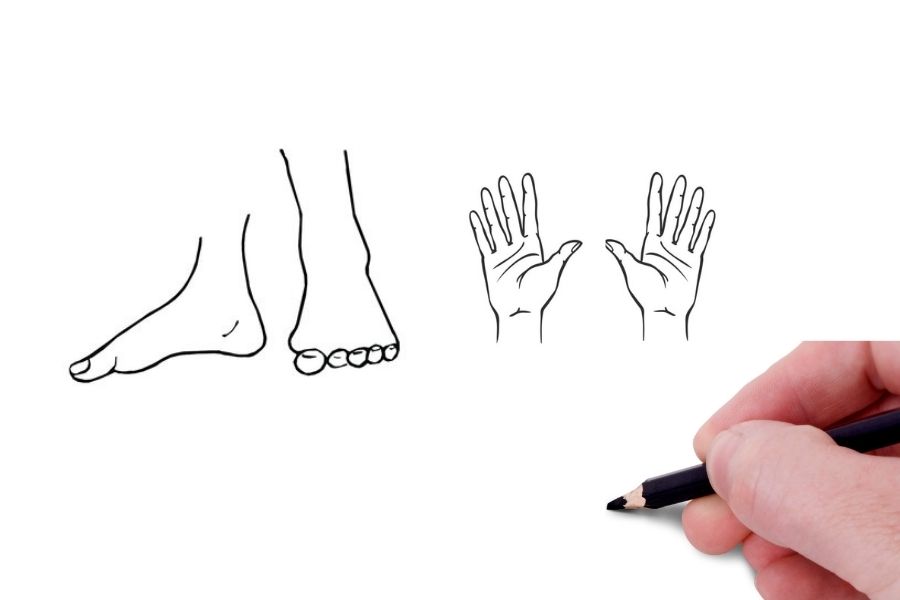
Drawing Apps
Step-by-step guide to draw human hands & feet
Step 1
Gather your Paper Pencil Eraser and Blending stump or tissue and put them on a flat surface.
Step 2
Sit where you have good light and place your hand or foot in front of you or set up the photo or mirror.
Step 3
Look carefully at the whole hand or foot and notice the big outer shape and how long the fingers or toes are.
Step 4
Lightly draw one simple shape for the palm or the main foot area like an oval or wedge to map the size.
Step 5
Draw straight gesture lines from the palm to the tips of the fingers or from the heel to the toes to show direction and length.
Step 6
Mark knuckles joints and the wrist or ankle with small circles to show where bends happen.
Step 7
Connect the shapes and lines with curved outlines to form each finger toe palm and heel.
Step 8
Erase the extra guide lines gently and adjust any fingers or toes that look too long or short.
Step 9
Add details like nails skin creases and the big shapes of the heel and muscle lines using light strokes.
Step 10
Decide where the light comes from then shade opposite the light using soft pencil strokes and blend with the stump or tissue.
Step 11
Do three quick 30 second gesture sketches of different hand or foot poses then pick your best finished drawing and share it on DIY.org
Help!?
What can we use if we don't have a blending stump, special pencils, or an eraser?
Use a rolled-up tissue, cotton swab, or clean fingertip in place of the blending stump, a regular HB pencil if you don't have drawing pencils, and a soft vinyl or kneaded eraser to gently lift guide lines.
My fingers or toes keep looking too long or short—how do I fix the proportions?
Follow the step to 'Draw straight gesture lines from the palm to the tips' and 'Mark knuckles joints...with small circles,' then erase extra guide lines gently and adjust lengths before connecting your curved outlines.
How can I adapt this activity for younger kids or older kids?
For younger children, have them trace their hand on larger paper and focus on simple shapes and light strokes without complex shading, while older kids should use a mirror or photo, do the three quick 30-second gesture sketches, add knuckle marks, and refine shading with a blending stump.
How can we extend or personalize the finished hand or foot drawing?
Create a mini-series by turning each of the three 30-second gesture sketches into a finished piece, add personalized details like nails and skin creases, experiment with different light directions when you 'Decide where the light comes from then shade opposite the light,' and share your favorite on DIY.org.
Watch videos on how to draw human hands & feet
How to Draw HANDS - Details for Realistic Hands!
4 Videos
How to Draw HANDS - Details for Realistic Hands!
How to Draw a Realistic Hand Step by Step | Easy Drawing Tutorial
![How to Draw Hands [ Simple Techniques to Remember ]](https://img.youtube.com/vi/yR9Tc-nYX4U/mqdefault.jpg)
How to Draw Hands [ Simple Techniques to Remember ]
How to Draw Hands - Human Anatomy Class Sneak Peek - 1 Hour Lesson
Facts about figure drawing for kids
🖐️ The human hand has 27 bones — about 1/8 of all the bones in an adult body!
🦶 The human foot contains 26 bones and around 33 joints, making it a clever natural shock absorber.
✏️ Gesture drawing exercises are often timed very short (30 seconds to 5 minutes) to train quick observation of pose and proportion.
🧠 A surprisingly large part of the brain's motor cortex controls the hands, which is why drawing hands improves hand–eye coordination.
🎨 Leonardo da Vinci made dozens of detailed hand studies to learn how muscles and tendons shape realistic gestures.
How do you practice drawing human hands and feet step by step?
What materials do I need to practice drawing hands and feet?
What ages is this activity suitable for?
What are the benefits of practicing drawing hands and feet?
