Solve the Last Layer Cross
Learn to solve the last layer cross on a 3x3 Rubik's Cube by practicing simple algorithms, observation skills, and step-by-step pattern recognition.
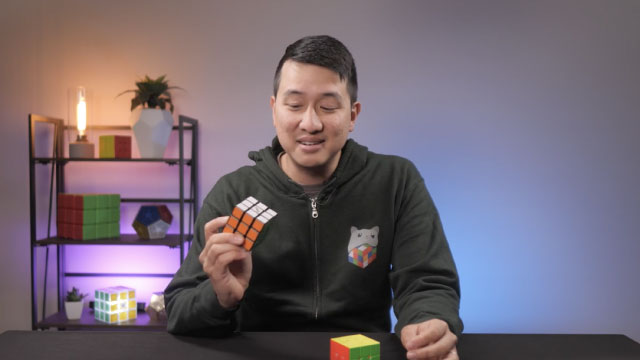
About this tutorial
Learn to solve the last layer cross on a 3x3 Rubik's Cube by practicing simple algorithms, observation skills, and step-by-step pattern recognition.
What you need
Step by step
- 1
Step 1
Hold the cube so the two solved layers are on the bottom and the unsolved last-layer color is on top.
- 2
Step 2
Look at the top face and name the pattern you see: dot L-shape line or cross.
- 3
Step 3
If you already see a cross on the top face go to Step 10 to share your success.
- 4
Step 4
If you see an L-shape turn the whole cube until the L sits in the top-left corner of the top face.
- 5
Step 5
If you see a line turn the whole cube so the line is horizontal across the top face.
- 6
Step 6
Perform this algorithm once by turning faces in this order: front clockwise right clockwise up clockwise right counterclockwise up counterclockwise front counterclockwise.
- 7
Step 7
Look at the top face again and repeat Steps 4 to 6 until the top shows a full cross.
- 8
Step 8
When the cross appears stop turning and check that all four top edge stickers match the top color.
- 9
Step 9
Practice the detect-orient-and-run routine a few more times from a dot pattern to build speed and confidence.
- 10
Step 10
Take a photo or note of your finished last-layer cross and share your achievement on DIY.org.
Fun facts
How do I teach my child to solve the last layer cross on a 3x3 Rubik's Cube?
To teach a child to solve the last layer cross, start with the cube’s first two layers solved and the last layer color on top. Teach them to recognize three patterns (dot, L-shape, line). Hold the cube with the L or line oriented correctly (L with its corner facing you, line horizontal), then apply the algorithm F R U R' U' F'. Repeat as needed until the top cross appears, practicing observation and pattern steps.
What materials do I need to practice the last layer cross?
You only need a standard 3x3 Rubik’s Cube (stickered or stickerless). Optional helpful items: a printed or digital guide showing patterns and the F R U R' U' F' algorithm, a mobile app or video tutorial, a small timer for practice, and a soft mat or table to catch a cube if dropped. No special tools required beyond the cube and a patient learning space.
What ages is learning the last layer cross suitable for?
Solving the last layer cross is suitable for children roughly aged 7 and up, once they can follow multi-step instructions and manipulate the cube confidently. Younger children (5–6) can try with adult help and simplified pattern recognition. Individual readiness varies—start with short practice sessions, encourage patience, and adapt explanations to the child’s attention span and fine motor skill level.
What are the benefits of practicing the last layer cross with my child?
Practicing the last layer cross builds pattern recognition, spatial reasoning, and short-term memory by repeatedly identifying and applying a single algorithm to changing patterns. It strengthens fine motor control and hand-eye coordination, teaches patience and focus, and boosts confidence as kids see measurable progress. It also provides a gentle introduction to algorithmic thinking useful in math and coding.
Watch & Learn
Need help?
What can we use if we don't have a physical Rubik's Cube or can't take a photo?
Use a free cube‑solving app or a printable cube net to practice the hold-and-orient steps, and if you can't take a photo for Step 10, draw the finished cross or save a screenshot instead.
The algorithm doesn't seem to make progress—what am I doing wrong?
Check that the two solved layers are on the bottom and that the L is placed in the top-left or the line is horizontal before performing the algorithm F R U R' U' F' exactly once, then repeat Steps 4–6 until a full cross appears.
How can I adapt this activity for different ages?
For preschoolers, have an adult hold the cube and let the child name dot/L/line patterns, for early school ages practice performing the single algorithm slowly, and for older kids time repeated 'detect-orient-and-run' routines to build speed.
How can we extend or personalize the activity after making the cross?
Extend it by timing multiple attempts from a dot to a cross, keeping a progress chart, decorating the cube stickers for personalization, and sharing the finished cross photo on DIY.org as suggested in Step 10.