Is cubing hard?
Learn step by step tricks to solve a 3x3 Rubik's Cube, practicing basic moves and simple algorithms to build speed and confidence.
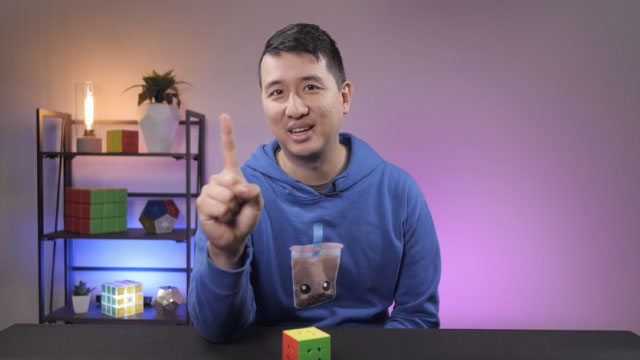
About this tutorial
Learn step by step tricks to solve a 3x3 Rubik's Cube, practicing basic moves and simple algorithms to build speed and confidence.
What you need
Step by step
- 1
Step 1
Hold the cube and look at the center pieces to learn which color belongs to each face.
- 2
Step 2
Learn the move names R L U D F B and the meaning of a ' after a letter for a counterclockwise turn.
- 3
Step 3
Practice single face turns by turning each face smoothly clockwise and counterclockwise until your fingers feel confident.
- 4
Step 4
Make a white cross by moving the four white edge pieces so the white stickers form a plus on the white center and each edge's side color matches the center of its face.
- 5
Step 5
Insert each white corner using the algorithm R U R' U' and repeat the algorithm until the corner sits correctly with white on the bottom.
- 6
Step 6
Put the four middle layer edges into place by moving a non-yellow edge to the top then using the edge insertion algorithm U R U' R' U' F' U F until that edge is in the middle; repeat for all middle edges.
- 7
Step 7
Make a yellow cross on the top by applying the algorithm F R U R' U' F' and repeating it until you see a plus sign on the yellow face.
- 8
Step 8
Turn each top corner so yellow faces up by using R' D' R D repeatedly on that corner until yellow is on top then rotate the top layer to the next corner.
- 9
Step 9
Put the yellow corners in the correct positions using the corner permutation algorithm U R U' L' U R' U' L until all corners are in their spots.
- 10
Step 10
Finish the cube by using the final edge permutation algorithm R U' R U R U R U' R' U' R2 until all pieces are in place and the cube is solved.
- 11
Step 11
Share your finished creation on DIY.org
Fun facts
How do you learn to solve a 3x3 Rubik's Cube step by step?
Start with the beginner layer-by-layer method: learn cube notation (R, L, U, D, F, B) and basic face turns. First make a white cross, place white corners to finish the first layer, solve the middle-layer edges, then make a top cross. Learn a few simple algorithms to orient and permute the top layer. Practice slowly, break the process into small steps, use video tutorials, and repeat algorithms until they become muscle memory.
What materials do I need to teach cubing to my child?
You need a 3x3 Rubik's Cube (stickerless cubes are kid-friendly), a timer app or simple stopwatch to track progress, and a printed or digital cheat sheet of beginner algorithms. Optional items include lubricant and a small screwdriver for tensioning, a soft mat to protect the cube, and tutorial videos or an app for guided lessons. A notebook for notes and practice logs helps motivation.
What ages is learning to solve a Rubik's Cube suitable for?
Cubing is generally suitable for children aged about 7 and up, when basic reading, pattern recognition, and fine motor skills are developing. Younger children (5–6) can learn with adult help and simplified steps. Older kids and teens pick up speed quickly. Adjust sessions to short practice bursts, and focus on fun and small wins to keep younger children engaged.
What are the benefits of learning to solve a Rubik's Cube for children?
Solving a cube builds problem-solving, spatial reasoning, memory, and pattern recognition. It improves fine motor skills, patience, concentration, and persistence through repeated practice. Cubing also boosts confidence as children master algorithms and time improvements, and can create social opportunities through clubs or contests. The activity links to math thinking without feeling like schoolwork.
Watch & Learn
Need help?
What can we use if we don't have a standard 3x3 Rubik's Cube?
If you don't have a 3x3, use a 2x2 to practice holding the cube, learning centers and smooth single-face turns, and the R U R' U' corner algorithm, but know the middle-layer edge and final edge-permutation algorithms won't apply.
My cube pieces don't line up when making the white cross—what should I do?
If the white cross edges won't match centers, keep white on the bottom, bring one target edge to the top with single-face turns, align its side color to the correct center, then insert it before moving to the next edge.
How can I adapt this activity for different ages?
For preschoolers focus on holding the cube and smooth clockwise turns and identifying center colors, elementary-age kids can work up to the white cross and R U R' U' corner inserts, and older kids can learn all algorithms including the middle-layer edge insertion and final edge permutation and practice timed solves.
How can we extend or personalize the activity after solving the cube?
After finishing, personalize by timing your solve and sharing it on DIY.org, applying custom stickers to the cube, learning finger-trick variants of the algorithms like the final edge-permutation R U' R U... to speed up, or creating pattern challenges such as checkerboards.