Make Figure Drawings
Make basic figure drawings from observation using pencil and paper, practicing proportions, simple poses, and light shading to show movement and volume.


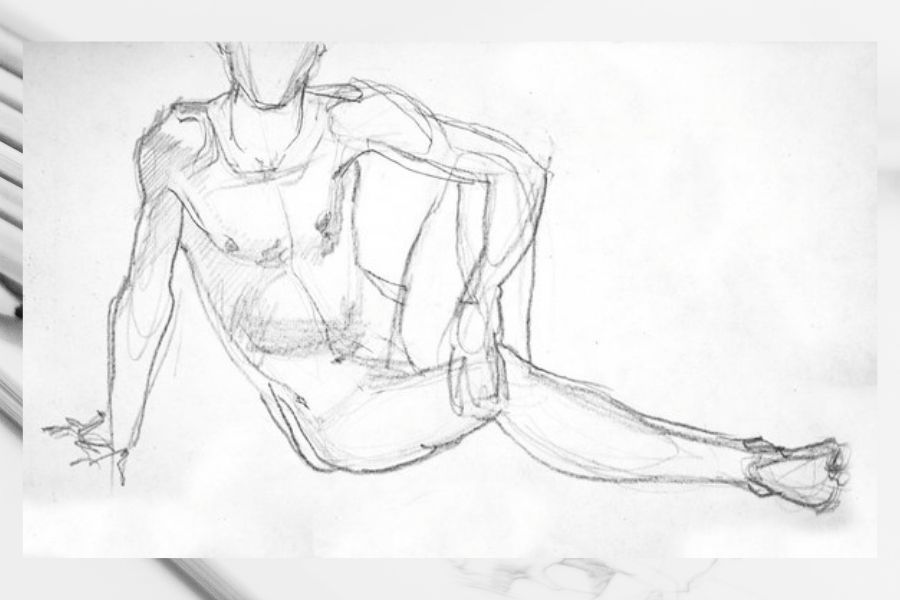
Drawing Apps
Step-by-step guide to make figure drawings from observation
Step 1
Gather your pencil eraser paper and sharpener and put them on a flat surface.
Step 2
Choose a model to draw like a toy a family member or a printed photo.
Step 3
Place the model where you can see it clearly and sit so your paper faces the model.
Step 4
Do three quick 30 second gesture lines on scrap paper to warm up your hand.
Step 5
Look at the whole pose and draw one single flowing line of action from head to feet.
Step 6
Hold your pencil up to the model and measure the head height to use as a unit.
Step 7
Mark that head unit on your paper and lighty divide the figure into head based proportions.
Step 8
Block in the head torso and pelvis with simple shapes like ovals and rectangles.
Step 9
Add circles for joints and light lines for the arms and legs to show limb directions.
Step 10
Refine the outer contour of the figure slowly and erase extra construction lines.
Step 11
Add light shading with soft pencil strokes following the forms to show volume and movement.
Step 12
Try two more quick poses using steps 4 to 11 to practice proportions and motion.
Step 13
Share your finished drawing on DIY.org
Help!?
What can I use if I can't find a pencil sharpener or scrap paper?
If you don't have a sharpener, use a mechanical pencil or a pre-sharpened pencil and substitute scrap paper with newspaper for the 30-second warmups in step 4.
My figure looks the wrong size — how do I fix proportions?
If the figure looks out of proportion after marking head units in step 6, hold your pencil up to the model again to remeasure and lightly correct the head marks before blocking in shapes in step 7.
How can I adapt this activity for different ages?
For younger children, simplify steps by using a toy model and drawing only big shapes from step 7 without measuring in step 6, while older kids can keep the 30-second gesture warmups (step 4) and add detailed shading in step 11.
How can we make the drawing more advanced or personal after finishing?
To extend the activity, try adding colored pencils or ink after refining the contour in step 11, practice foreshortening and different models during the two extra poses (steps 4–11), and post your progress on DIY.org.
Watch videos on how to make figure drawings from observation
How to DRAW Figure in 5 mins using Simple SHAPES and Lines
4 Videos
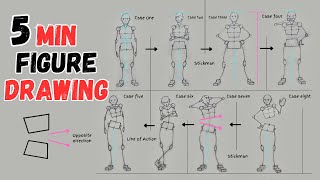
How to DRAW Figure in 5 mins using Simple SHAPES and Lines
How to draw HUMAN FIGURE for KIDS and BEGINNERS // Easy human figure drawing // Drawing for kids
Quick & Easy Human Figure Drawing | Perfect for Beginner Artists | elementary intermediate
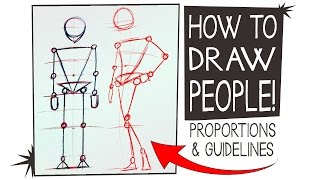
A Simple Guide to Figure Drawing - HOW TO ART
Facts about figure drawing for kids
🖊️ Quick gesture sketches (30–60 seconds) help artists capture movement and energy before adding details.
📏 Many artists measure the human body in "heads" — an average adult figure is roughly 7.5–8 heads tall.
⏱️ Life-drawing sessions often include timed poses that range from 30 seconds up to 20 minutes to train speed and observation.
🌓 Chiaroscuro (Italian for "light-dark") is a shading trick used by masters to turn flat drawings into 3D-looking forms.
🧠 Drawing people from observation strengthens visual memory and makes you notice small details you might otherwise miss.
How do I teach my child to make basic figure drawings from observation?
What materials do I need for children to practice figure drawing with pencil and paper?
What ages is basic figure drawing from observation suitable for?
What are the benefits of practicing basic figure drawing for children?
