Orchestrate a big game
Plan and run a large outdoor team game: choose rules, divide players into teams, design safe challenges, set time limits, and referee fairly.


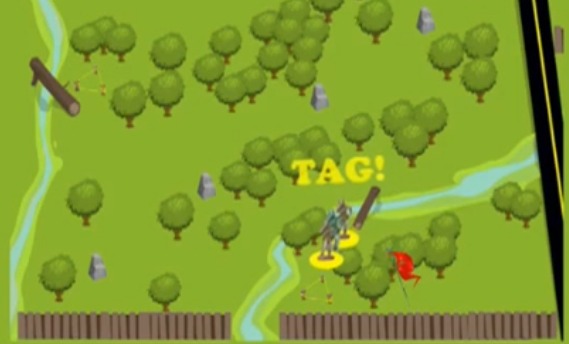

Step-by-step guide to plan and run a large outdoor team game
How To Sort Objects for Kids | Sorting & Matching Games for Children | Kids Academy
Step 1
Pick a fun theme and a clear objective for your big outdoor team game.
Step 2
Write five simple rules that explain how to score how to win and how to stay safe.
Step 3
Divide players into teams and decide how many players go on each team.
Step 4
Give each team a visible identifier like a band or a colored shirt.
Step 5
Design three safe challenge stations or tasks that match your theme.
Step 6
Choose a playing area and mark clear boundaries so everyone knows where to play.
Step 7
Decide time limits for each round and how many rounds you will play.
Step 8
Gather all materials and place them at the challenge stations.
Step 9
Set up a visible scoreboard and a timer in an obvious spot.
Step 10
Choose one person to update the scoreboard during the game.
Step 11
Explain the rules boundaries time limits and scoring to all players so everyone understands.
Step 12
Run one short practice round so teams can try the challenges and ask questions.
Step 13
Start the full game by beginning the first round on the timer.
Step 14
Tally final scores and announce the winning team while praising fair play.
Step 15
Share your finished game plan and highlights on DIY.org
Help!?
I don't have colored shirts or bands — what can I use instead?
Use colored cones, sticker dots, bandanas, different hats, or laminated name tags as visible identifiers in place of the band or colored shirt mentioned in the 'Give each team a visible identifier' step.
What if players don't understand the rules or rounds get chaotic?
Run the short practice round, clearly explain the rules, boundaries, time limits, and scoring to all players, and appoint the person who updates the scoreboard to act as referee to keep rounds orderly.
How can I adapt the game for younger or older kids?
For younger kids simplify scoring, shorten time limits, reduce team sizes, and make the three challenge stations easier, while for older kids increase challenge difficulty, add more rounds, and introduce bonus scoring options when you 'Design three safe challenge stations' and 'Decide time limits for each round'.
How can we make the game more exciting or shareable?
Amp up a bold theme, add music and small prizes, decorate team identifiers and challenge stations, keep a visible scoreboard and take photos during play, then share your finished game plan and highlights on DIY.org as instructed.
Watch videos on how to plan and run a large outdoor team game
Matching, Sorting & Logic Games and Activities | Preschool & Kindergarten | Kids Academy
4 Videos

Matching, Sorting & Logic Games and Activities | Preschool & Kindergarten | Kids Academy
Sorting and Matching Activities. Same and Different for Preschool and Kindergarten - Kids Academy
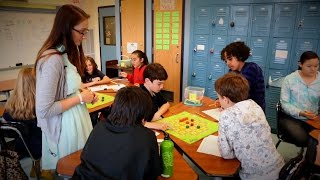
Managing Game-Based Learning in the Classroom
Games-Based Learning 1: Integrating Play and Learning.
Facts about organizing outdoor games for kids
🕒 Many outdoor team games use clear time limits (like 10–15 minute rounds) to keep energy high and play fair.
⚖️ A neutral referee or rotating referees reduces disputes and helps players trust the rules.
🧩 Balancing teams by age or mixed skill levels makes matches more fun and competitive.
🦺 A quick safety check (no sharp objects, clear play area) and simple safety rules prevent most playground injuries.
🏆 Simple scoring and clear win conditions make games easier to learn and easier to referee.
How do I plan and run a large outdoor team game?
What materials do I need to organize a big outdoor team game?
What ages is this activity suitable for?
How can I keep kids safe when running a large outdoor team game?
