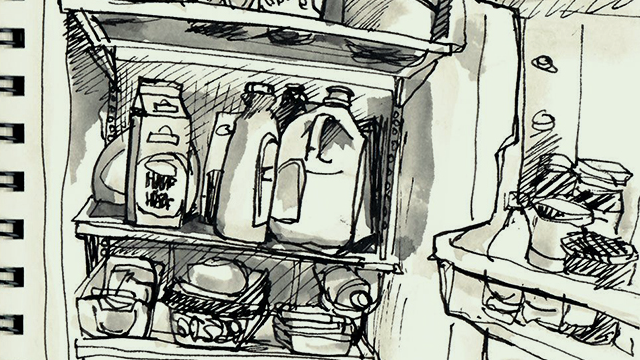
Draw what's in your fridge
Look inside your fridge, then draw and label the different foods and containers to practice observation, shapes, colors, and relative sizes.


Drawing Apps
Step-by-step guide to draw what's in your fridge
Step 1
Put your paper pencil and coloring materials on a flat table.
Step 2
Open the fridge door.
Step 3
Look slowly at the shelf or drawer you want to draw.
Step 4
Choose three to six different foods or containers from that shelf to draw.
Step 5
Close the fridge door.
Step 6
Lightly sketch the big shapes of each chosen item showing which ones are bigger or smaller.
Step 7
Add details like lids labels and textures to each sketch.
Step 8
Color each item using the same colors you saw in the fridge.
Step 9
Write the name of each item next to its drawing as a label.
Step 10
Give your picture a title at the top.
Step 11
Share your finished creation on DIY.org.
Help!?
What can we use if we don't have the paper, pencil, coloring materials, or a flat table listed in the instructions?
If you don't have the specified paper, pencil, or coloring materials, use plain printer paper or cardboard, a pen or crayon for sketching and coloring, and a clipboard or the back of a hardcover book as a flat table substitute.
What should we do if our drawing looks crowded or the sizes of items don't match what we saw in the fridge when following the 'Lightly sketch the big shapes' step?
If the sketch looks crowded or sizes are off during the 'Lightly sketch the big shapes' step, erase lightly, redraw the largest items first, remove one or two chosen items, and leave more space between shapes to match the shelf layout you observed.
How can we adapt the activity for different ages when choosing items, adding details, and labeling?
For younger kids simplify step 4 to choose 1–3 items and focus on big shapes and basic colors, while older children can pick 4–6 items, add textures and labels in step 6 and write more detailed names in step 8.
What are some ways to extend or personalize the activity after finishing the drawing and title?
To extend the activity, add dates or short recipes next to the labeled items, create patterns or backgrounds for personalization, photograph the finished picture, and share it on DIY.org as directed in the final step.
Watch videos on how to draw what's in your fridge
Fridge Organization Using Smart Products | Practical Ways to Organize Your Fridge
4 Videos

Fridge Organization Using Smart Products | Practical Ways to Organize Your Fridge

10 Simple Amazing KIDS ACTIVITY IDEAS to keep them entertained | 2+ years CHILDREN ACTIVITIES
FRIDGE ORGANIZATION in 5 EASY STEPS + Clean & Organize with Me
ULTIMATE Fridge Organization IN 5 Easy Steps! MissLizHeart
Facts about observational drawing for kids
🧊 Refrigerators keep food cold to slow bacteria, helping leftovers last longer and stay safe to eat.
🎨 Still life is an art genre that artists use to practice shapes, light, and texture—great for drawing fridge items.
👀 Observational drawing is more about looking carefully than hurried sketching; artists often study the subject before each mark.
🍎 Fruits and vegetables bring bright, natural colors to a fridge—easy, cheerful subjects for practicing color matching.
📏 Comparing a milk carton to a jam jar teaches scale and relative size, an important drawing skill for kids.
How do I do the "Draw what's in your fridge" activity with my child?
What materials do I need for the fridge observation and drawing activity?
What ages is the "Draw what's in your fridge" activity suitable for?
What are the benefits, safety tips, and variations for this fridge drawing activity?
