Build a balance beam
Build a low, safe balance beam from a wooden plank or sturdy foam, attach supports, test balance, and explore center of gravity with adult supervision.


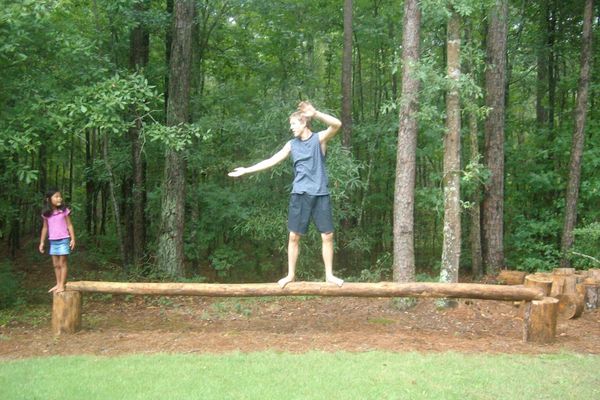

Step-by-step guide to build a low, safe balance beam
Tricks to Help Kids Walk on a Balance Beam! Pediatric Exercises for Dynamic Balance #28
Step 1
Gather all the materials and bring them to a flat open space.
Step 2
Clear the area of toys and obstacles so you have lots of room to work.
Step 3
Lay the plank flat and use the measuring tape and pencil to mark the center point.
Step 4
Sand any rough edges or splinters on the plank until it feels smooth.
Step 5
Stick a strip of non slip tape along the top center of the plank for better grip.
Step 6
Place the two low supports on the floor spaced so the plank will rest low about one to three inches above the ground.
Step 7
Carefully set the plank across the supports so the center mark sits midway and the plank looks level.
Step 8
Press down in the middle of the plank with your hand to check that it is stable while an adult watches.
Step 9
Step onto the plank with one foot then the other and walk slowly while an adult spots you for safety.
Step 10
Put the beanbag on the center mark and watch whether the plank stays level to learn about balance.
Step 11
Move the beanbag toward one end and watch which side dips to explore how weight changes the center of gravity.
Step 12
Share a photo or video of your finished balance beam and what you learned on DIY.org.
Help!?
What can I use if I can't find non-slip tape, a wide plank, or two low supports?
Use shelf‑liner or double‑sided grip contact paper stuck along the top of a sturdy plywood board or old wide shelf, and use low, stable supports such as yoga blocks, cinder blocks, or stacked heavy books spaced so the plank sits 1–3 inches high.
The plank wobbles or tips when I press the middle—what should I check or fix?
Make sure the center mark really sits midway by remeasuring, move the two supports so they're equidistant from the ends, add non‑slip material under each support, and sand any uneven spots on the plank so it rests flat and stable.
How can I adapt this balance beam for toddlers or for older kids?
For toddlers use a wider plank with supports only an inch high, an adult holding hands or a low handrail, and a beanbag at the center for a simple balance game, while for older kids raise the supports slightly, use a longer plank, add timed walks, or require carrying the beanbag to shift the center of gravity.
How can we extend or personalize the balance beam activity after it's built?
Decorate the plank with non‑toxic paint and numbered stepping zones, create challenges like walking backwards, timing runs, or moving the beanbag to different marks to observe how the beam dips, and then share a photo or video of the finished beam and discoveries on DIY.org.
Watch videos on how to build a low, safe balance beam
Gymnastics for Children - Balance Beam Drills - Coach Amy Eggleston
4 Videos

Gymnastics for Children - Balance Beam Drills - Coach Amy Eggleston
How to do BEAM BASICS! by MGA Gymnastics
" Toddler Gymnastics: Fun Balance Beam Activities for Early Skill Development!"
👉 Fun Balance Beam Exercise for Kids | Improve Focus, Impulse Control & Balance! #31
Facts about woodworking and balance activities for kids
🤸 The Olympic balance beam is 5 meters long and only 10 centimeters wide (about 4 inches).
⚖️ You stay balanced when your center of mass stays over your base of support — move your arms or legs and the center shifts.
🧠 Your inner ear (the vestibular system) and your eyes team up to help your brain know which way is up.
🦶 Practicing barefoot or with grippy socks on a low beam helps kids feel the plank better and improves balance control.
🪵 A low wooden plank or dense foam beam with wide, sturdy supports is a great, safer option for beginners.
How do you build a low, safe balance beam for kids?
What materials do I need to build a child-safe balance beam?
What ages are suitable for a homemade balance beam?
What are the safety tips and benefits of using a balance beam?
